
Victorian Tile Restoration & Repair FAQs
Victorian tile floors are a defining feature of period properties throughout Edinburgh, Glasgow and across Scotland. Found in entrance vestibules, hallways, churches, civic buildings and listed properties, these geometric and encaustic floors were built to last. With the correct conservation techniques, most original Victorian tile floors can be restored rather than replaced.
At Victorian Tile Restoration & Repair, we specialise in the cleaning, repair and conservation of Victorian tile floors throughout Scotland, while also undertaking larger heritage projects across the UK. Using conservation-led methods, we preserve as much original historic fabric as possible while restoring the appearance, stability and longevity of historic tiled floors.
Below you’ll find answers to the questions we’re most frequently asked about Victorian tile restoration, including costs, specialist cleaning, replacement tiles, repairs, listed buildings, new Victorian-style floor installations and how to obtain a quotation. If you can’t find the answer you’re looking for, please get in touch and we’ll be happy to help.
Frequently Asked Questions
1. How much does Victorian tile restoration cost?
2. Can you provide a quotation from photographs?
3. Should I restore or replace my Victorian tile floor?
4. Can damaged, loose and missing Victorian tiles be repaired?
5. Can you match original Victorian floor tiles?
6. How do you clean and seal Victorian floor tiles?
7. Can Victorian mosaics and encaustic tiles be restored?
8. Do you work on listed buildings, churches and historic properties?
9. Do you install new Victorian-style tile floors?
10. How do I arrange a quotation?
How much does Victorian tile restoration cost?
The cost of Victorian tile restoration depends on the size, condition and complexity of the floor, together with the level of conservation work required. Every project is individually assessed, and we provide a detailed written quotation from photographs or, where appropriate, a site visit.
Guide Prices
• Specialist Victorian tile cleaning and restoration – from £75 + VAT per m²
• Replacement geometric tiles from stock – from £14 + VAT per tile
• Specialist colour-matched replacement tiles – from £75 + VAT per tile
• Handcrafted encaustic replacement tiles – from £125 + VAT per tile
• Conservation consultancy, condition surveys and reports – from £495 + VAT
Costs are influenced by floor size and complexity, loose or missing tiles, the condition of the original bedding and subfloor, previous unsuitable repairs, whether lifting and relaying is required, the availability of matching tiles, and site access or listed building requirements.
We restore Victorian tile floors throughout Edinburgh, Glasgow and Scotland. Restricted access, parking permits or extended unloading times may affect the final quotation.
Restoration is usually considerably more economical than replacement while preserving the craftsmanship, architectural character and historic significance of the original floor.
For an accurate quotation, simply send photographs, approximate measurements and your location. Most domestic projects can be priced from photographs, while larger or listed building projects may require a site visit or conservation condition survey.
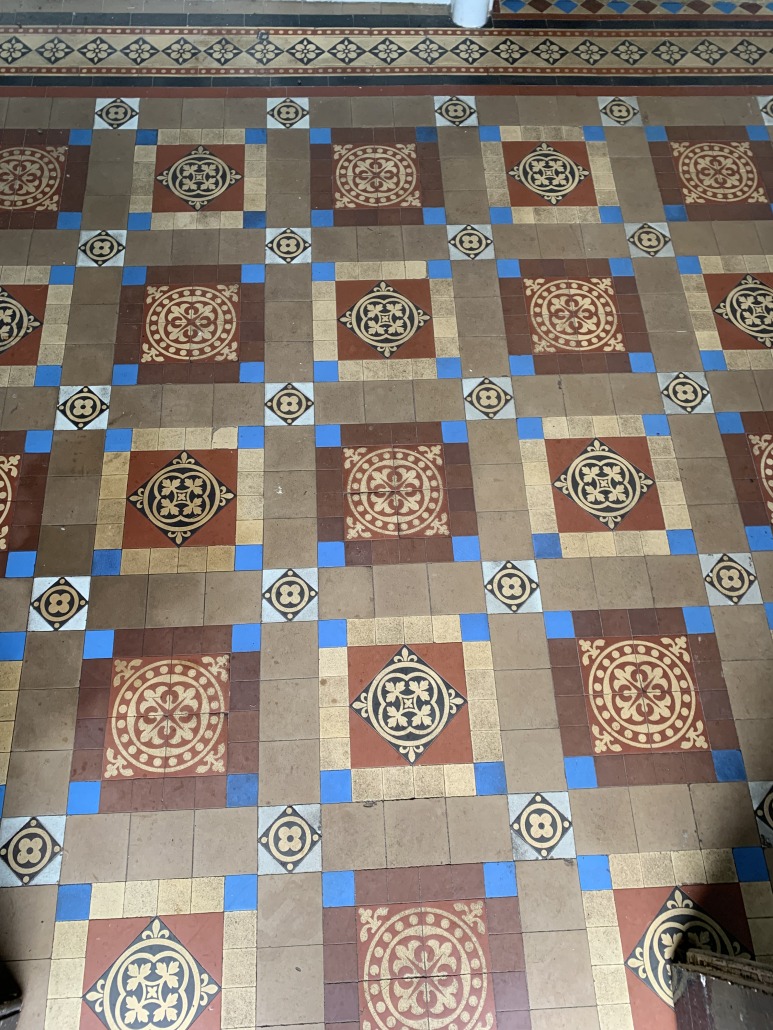
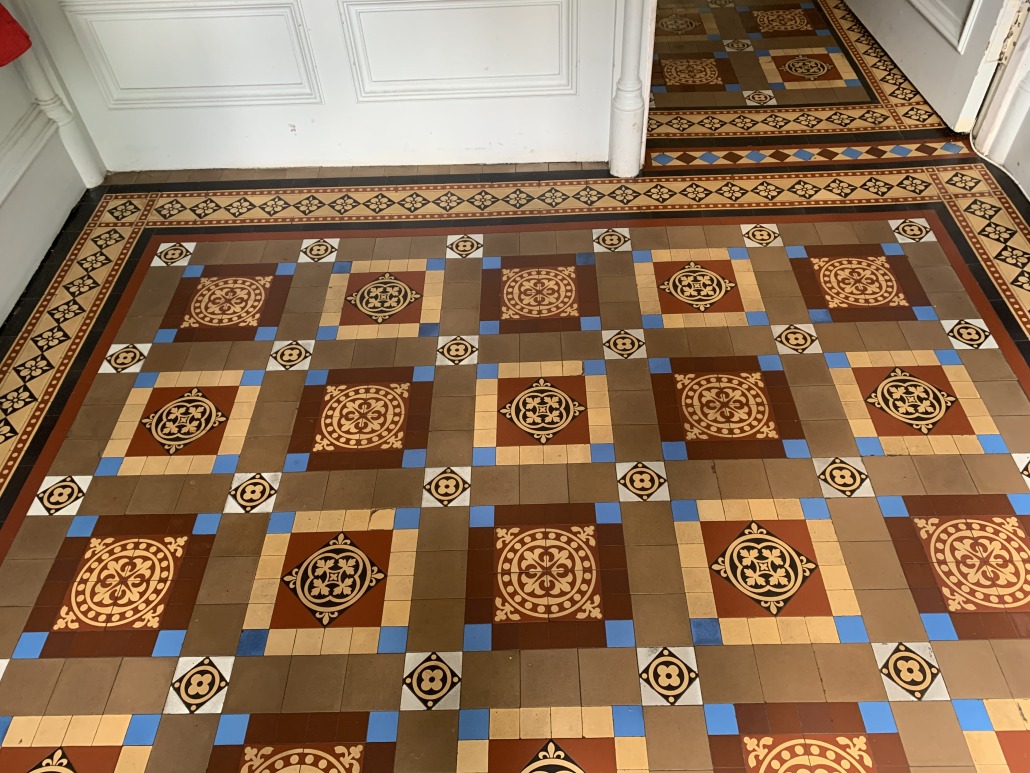
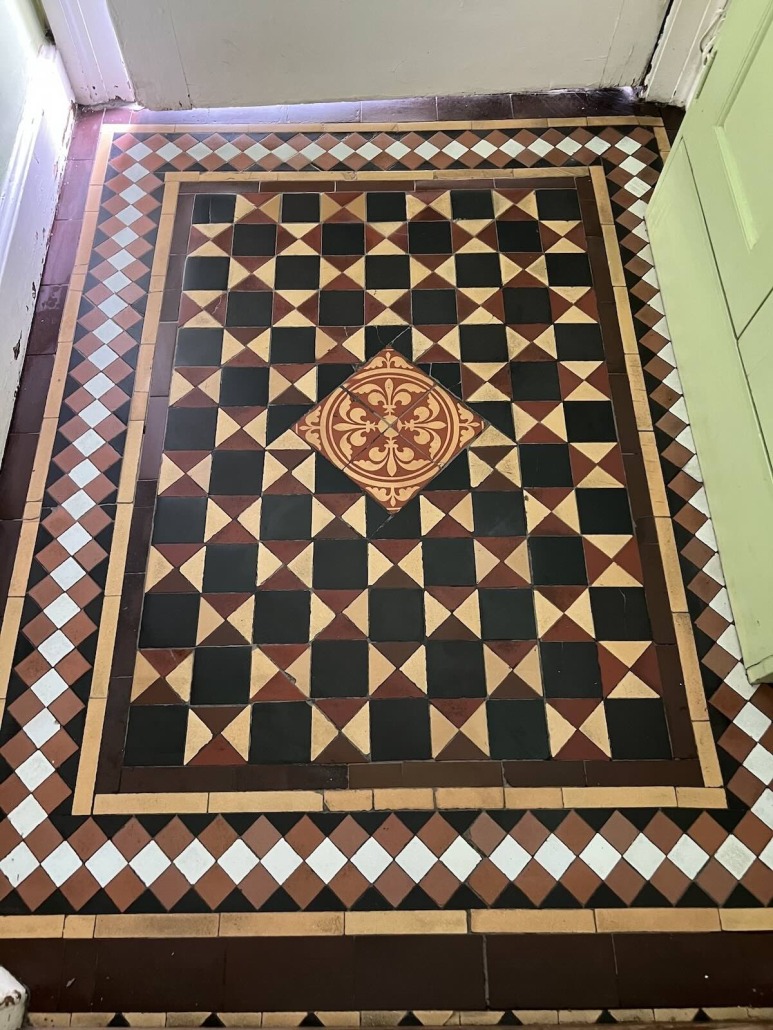
This Victorian tile restoration project in Bruntsfield, Edinburgh involved specialist conservation cleaning to remove decades of dirt, polish and surface contamination. Cleaning revealed the original colours and geometric design while preserving the historic patina. We regularly undertake Victorian tile restoration, cleaning and geometric floor repairs throughout Edinburgh, including Bruntsfield, Morningside, Marchmont, Stockbridge, Trinity, Comely Bank and the West End.
2. Can you provide a quotation from photographs?
Yes. Most domestic Victorian tile restoration projects can be accurately assessed from clear photographs and approximate measurements, allowing us to prepare a detailed written quotation without a site visit.
Please send:
• An overall photograph of the floor
• Close-up photographs of damaged or missing tiles
• Approximate dimensions
• Your location
• A brief description of any known issues
For larger conservation projects, including listed buildings, churches, cathedrals, scheduled monuments and other historic properties, we may recommend a site visit to assess previous repairs, the condition of the floor and any structural issues before preparing a specification and quotation.
Where distance is a factor, we’re also happy to discuss projects by telephone or video call. We provide Victorian tile conservation consultancy throughout the UK, including condition surveys, conservation reports and technical advice for homeowners, architects, surveyors, churches and heritage organisations.
3. Should I restore or replace my Victorian tile floor?
In most cases, conservation is the preferred approach. Original Victorian floor tiles were manufactured to an exceptionally high standard and can often be repaired and preserved rather than replaced.
Restoration retains the craftsmanship, character and architectural significance of the original floor while usually proving more cost-effective than complete replacement. Loose tiles can often be re-fixed, damaged areas repaired and missing tiles replaced using reclaimed, reproduction or handcrafted encaustic tiles.
Complete replacement is generally recommended only where extensive structural damage has occurred or very little of the original floor survives. Our aim is always to preserve as much original material as possible while ensuring the restored floor remains durable and appropriate to the building.
A professionally restored Victorian tiled floor can also enhance the appearance and value of a property, creating an impressive entrance while preserving an important part of its architectural heritage.
This Victorian tile restoration project in Hyndland, Glasgow involved reinstating a section of original geometric flooring removed for electrical services. Carefully matched replacement tiles were installed to restore the historic design and blend seamlessly with the surrounding floor. We regularly undertake Victorian tile restoration, tile matching and geometric floor repairs throughout Glasgow, including Hyndland, Hillhead, Partick, Kelvinside, Dowanhill, Jordanhill, Bearsden and Glasgow’s West End.
4. Can damaged, loose and missing Victorian tiles be repaired?
Yes. Most damaged Victorian tile floors can be repaired without replacing the entire floor, preserving as much original material as possible.
Loose tiles are lifted and re-bedded using appropriate conservation materials. Missing tiles are replaced with reclaimed, reproduction or handcrafted tiles matched to the existing floor, while cracked or chipped tiles can often be stabilised and retained.
We also investigate the underlying cause of failure, whether movement, failed bedding, impact damage or previous unsuitable repairs, helping to prevent future deterioration and provide a longer-lasting repair.
5. Can you match original Victorian floor tiles?
In many cases, yes.
We maintain a large stock of reclaimed Victorian geometric tiles in a wide range of colours, shapes and sizes. Where originals are unavailable, we source high-quality reproduction tiles or commission handcrafted encaustic replacements.
Matching Victorian tiles involves far more than colour. We assess size, thickness, profile, finish, laying pattern and natural patina to ensure repairs blend with the surrounding floor.
Although exact matches cannot always be achieved, particularly where original tiles are no longer manufactured, our aim is always to produce repairs that respect the character of the original floor.
We regularly undertake Victorian tile replacement, geometric tile matching and encaustic tile restoration throughout Edinburgh, Glasgow and across Scotland for homeowners, architects, churches and conservation professionals.
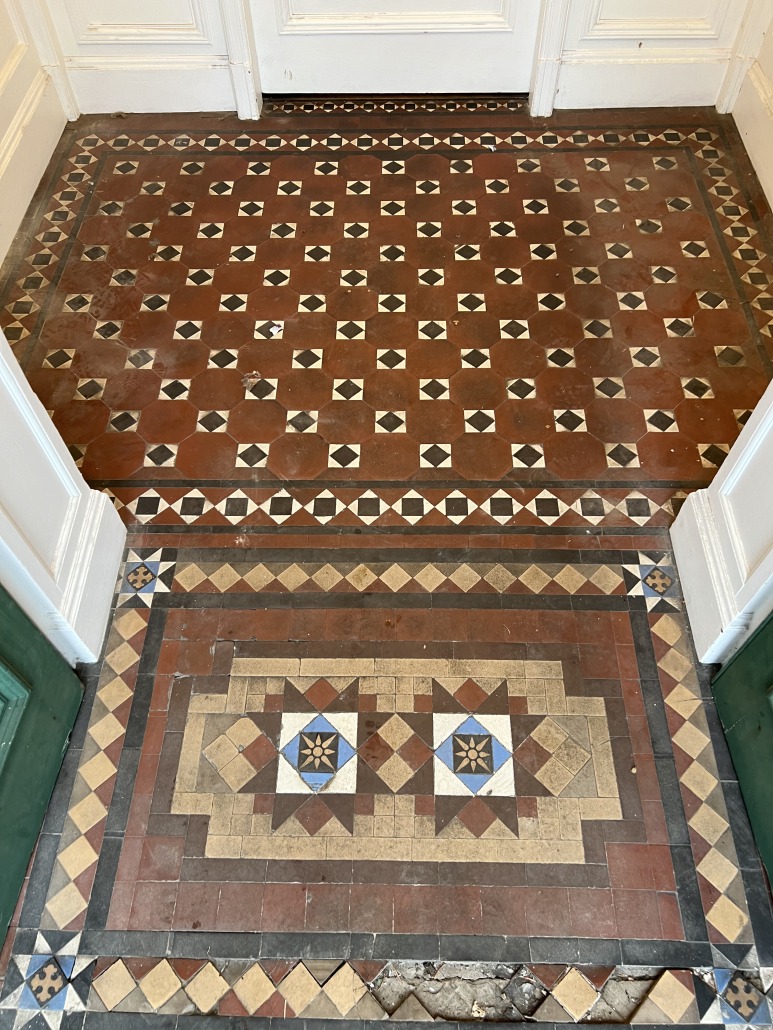
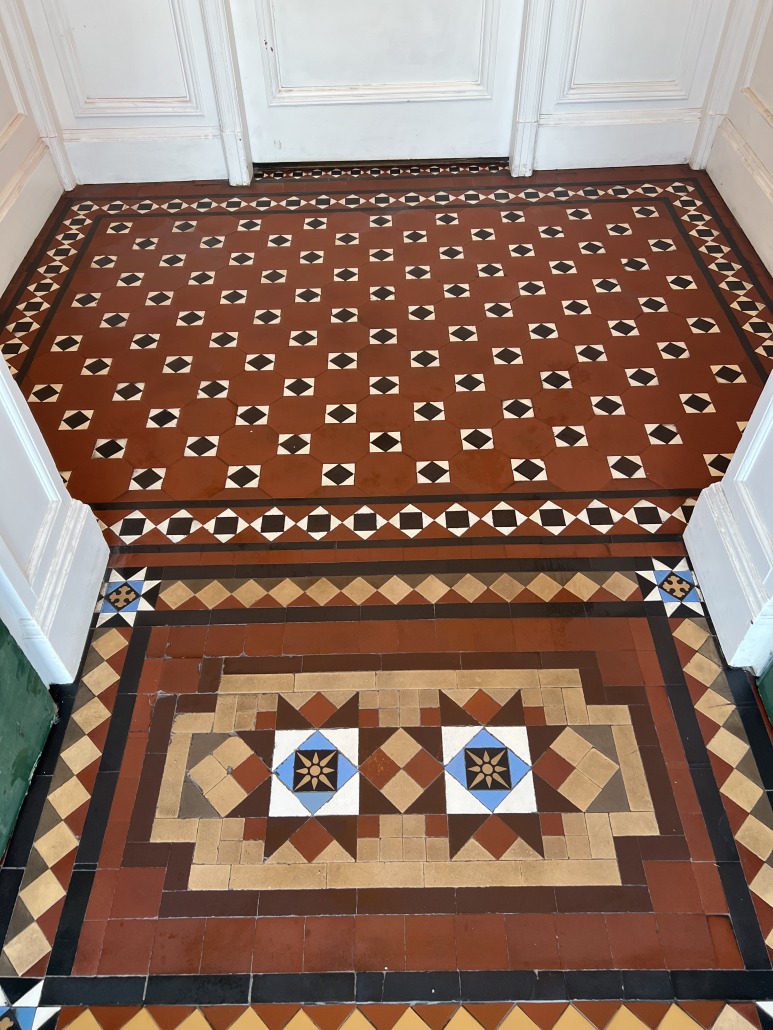
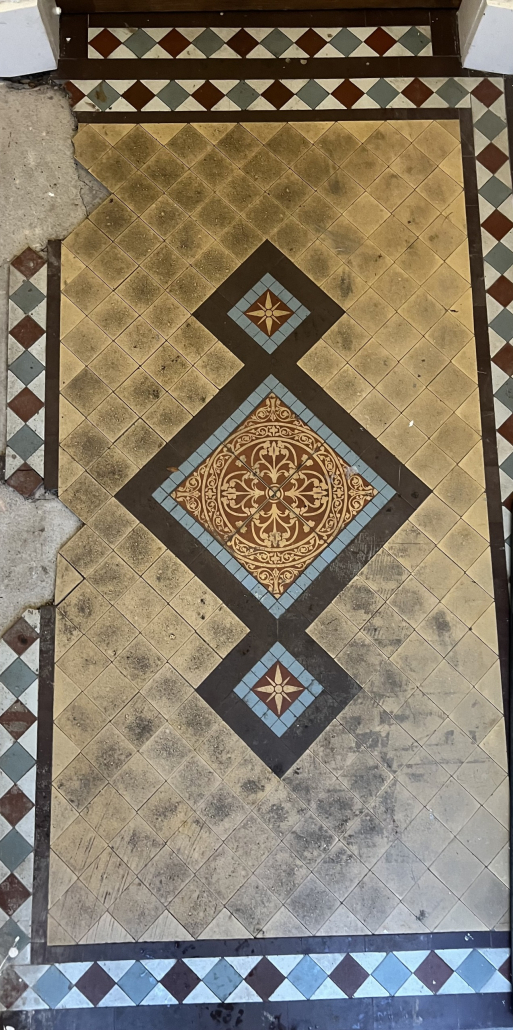
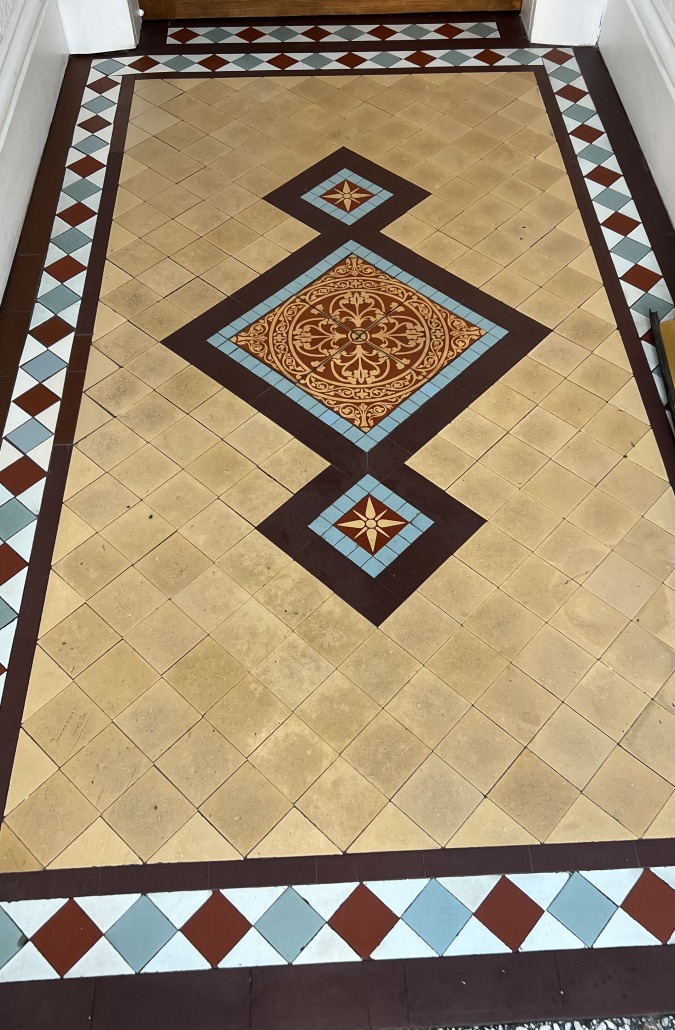
This before and after photos of a Victorian tile floor conservation project was carried out at a period property in Inverleith, Edinburgh, where years of accumulated dirt had obscured the original colours and decorative geometric design. The entrance threshold had also suffered localised damage, with several original Victorian tiles missing and requiring sympathetic conservation.
Using specialist conservation cleaning methods, we carefully removed decades of ingrained dirt and previous surface residues to reveal the original character of the historic tiled floor. Loose tiles were stabilised, damaged areas prepared for repair and the floor finished with a breathable protective treatment suitable for historic Victorian tiles.
Rather than replacing large sections unnecessarily, the project followed a conservation-led approach, retaining as much original Victorian fabric as possible while preparing the damaged threshold for reinstatement using carefully matched replacement geometric tiles.
The completed works restored the appearance, stability and long-term durability of this beautiful Victorian entrance floor while preserving its historic character. Today the floor once again provides an attractive and authentic entrance to this Inverleith property, demonstrating how specialist conservation techniques can successfully preserve original Victorian tile floors for future generations.
6. How do you clean and seal Victorian floor tiles?
Every Victorian tile floor requires an individual approach based on its age, condition and previous treatments.
Many historic floors have been coated with waxes, acrylic sealers or unsuitable modern finishes that trap dirt, dull the colours and prevent the floor from breathing. We first identify previous treatments before selecting the most appropriate conservation cleaning method.
Depending on the condition of the floor, we use specialist cleaning products, gentle mechanical cleaning or carefully controlled solvent treatments to remove old sealers, polish residues and ingrained dirt without damaging the original surface.
After cleaning, any repairs are completed before applying a breathable protective finish that enhances the natural appearance of the tiles while helping reduce staining, moisture ingress and everyday wear.
Our aim is to preserve the original patina rather than create an artificial high-gloss finish, ensuring the floor remains attractive and easy to maintain.
Glasgow West End Victorian Tile Cleaning Project
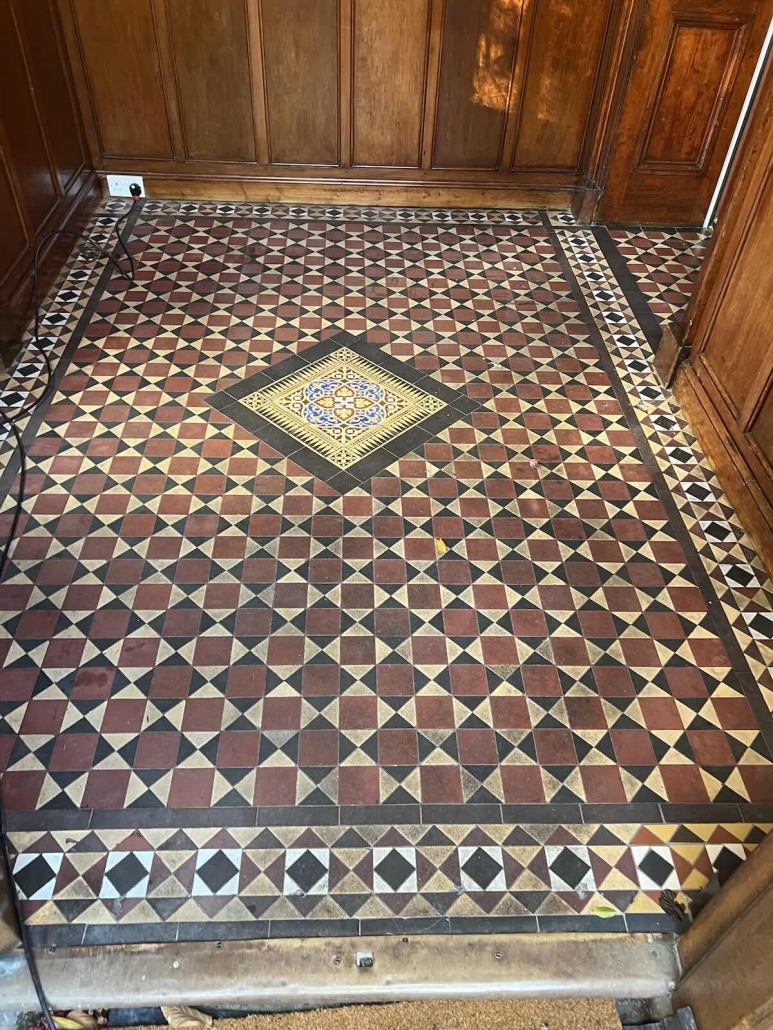
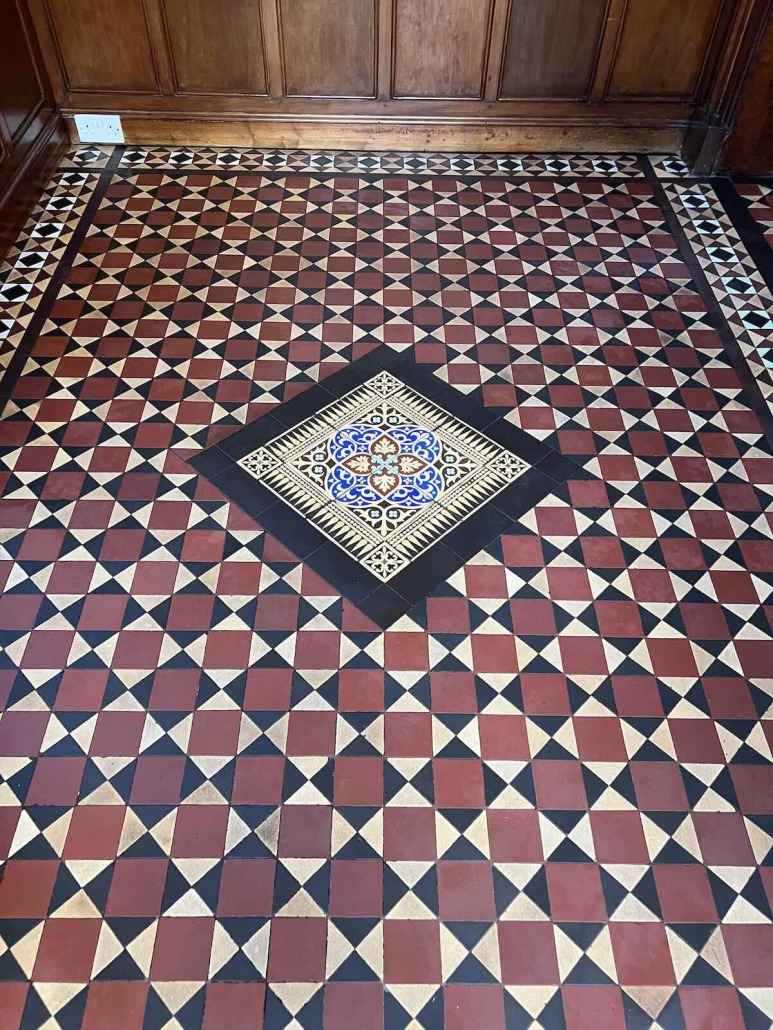
The before and after photographs above show the results of careful cleaning and conservation of an original Victorian geometric tile floor in Glasgow’s West End.
Years of ingrained dirt and surface contamination had dulled the red, black and cream tiles and obscured the decorative centrepiece. Careful cleaning revealed the original colours and geometric pattern while retaining the natural variation and patina of the historic floor.
Following cleaning, the floor was treated with a breathable impregnating sealer. Rather than coating the tiles with wax, acrylic or another surface finish, the impregnating treatment protects and refreshes the tiles while retaining their natural appearance and allowing moisture vapour to pass through the floor. The intention is a natural, enriched finish rather than a glossy or highly polished surface.
This approach also makes ongoing maintenance very simple. In normal use, the floor should require little more than light dusting and, when necessary, gentle mopping with a well-wrung mop. Routine use of strong cleaning chemicals, detergents, waxes or polishes is unnecessary and can gradually alter the appearance of the historic tiles.
This project demonstrates how even a heavily soiled Victorian tiled floor can often be successfully restored and maintained without unnecessary replacement or heavy surface coatings.
7. Can Victorian mosaics and encaustic tiles be restored?
Yes. Victorian mosaics and encaustic tiles can often be successfully restored using specialist conservation techniques.
Victorian mosaics commonly suffer from loose tesserae, worn joints, missing sections, previous cement repairs and heavy surface soiling. Encaustic tiles require particular care because their decorative pattern is formed from coloured clay inlays rather than a surface glaze, making abrasive cleaning unsuitable.
Where required, loose tesserae are re-bedded, damaged areas repaired and missing pieces replaced using reclaimed, reproduction or handcrafted materials selected to complement the original floor.
We regularly undertake Victorian mosaic restoration, encaustic tile conservation, Minton tile repair and geometric floor restoration within churches, cathedrals, listed buildings, civic properties and private homes throughout Scotland and across the UK.
8. Do you work on listed buildings, churches and historic properties?
Yes. Conservation of historic buildings is at the heart of our work.
We specialise in Victorian tile restoration, geometric tile repair, encaustic tile conservation and historic mosaic restoration within listed buildings, churches, cathedrals, civic buildings, museums, country houses and other heritage properties throughout Scotland and across the UK.
We regularly work on Category A, B and C listed buildings & scheduled monuments collaborating with architects, conservation architects, surveyors, conservation officers, archaeologists, heritage consultants and planning authorities where required.
Our expertise extends beyond Victorian tile floors to the conservation of stonework, marble flooring, mosaics and flagstones. This wider understanding allows us to identify the underlying causes of deterioration, including moisture ingress, structural movement, failed cement repairs and substrate failure, ensuring repairs address the cause rather than simply the symptoms.
We also prepare conservation condition surveys, technical reports, repair specifications, maintenance strategies and consultancy documents for homeowners, architects, churches, local authorities and heritage organisations.
Every project follows recognised conservation principles, including minimum intervention, repair before replacement and the use of compatible traditional materials, ensuring historic fabric is preserved wherever possible.
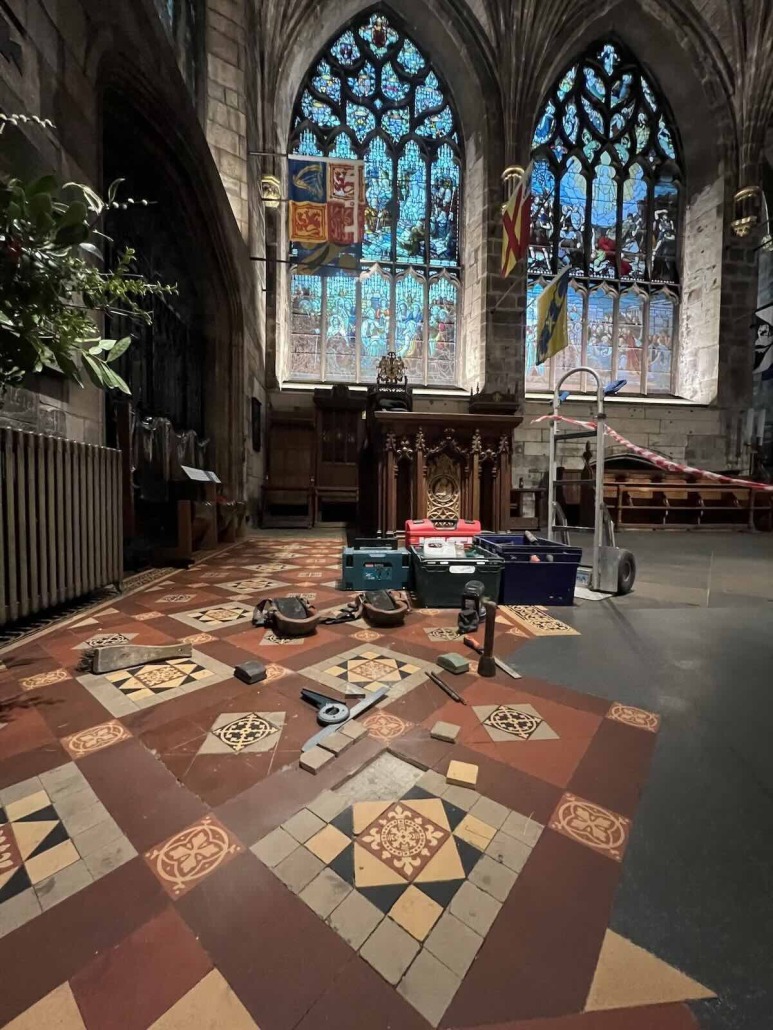
Above: This specialist conservation project at St Giles’ Cathedral, Edinburgh demonstrates the experience and expertise we bring to Victorian tile conservation and historic floor repair. Suitable replacement tiles were carefully matched from our extensive studio stock, then supplied and installed within this sensitive historic setting. The works were planned to avoid unnecessary ground disturbance, undertaken in accordance with statutory and conservation requirements, and completed within the agreed programme and access restrictions of a busy historic building.
9. Do you install new Victorian-style floors?
Yes. Alongside restoring original Victorian tile floors, we also design and install new Victorian-style geometric and encaustic tiled floors for period and contemporary properties.
Whether replacing a lost historic floor or creating a new entrance inspired by Victorian designs, we supply and install high-quality geometric floors using traditional laying techniques.
We work with homeowners, architects and interior designers to create floors that complement the character of each property. Designs range from simple Victorian borders to more elaborate geometric and encaustic patterns.
Where part of an original floor survives, we can often design and install a complementary new section that respects the remaining historic fabric.
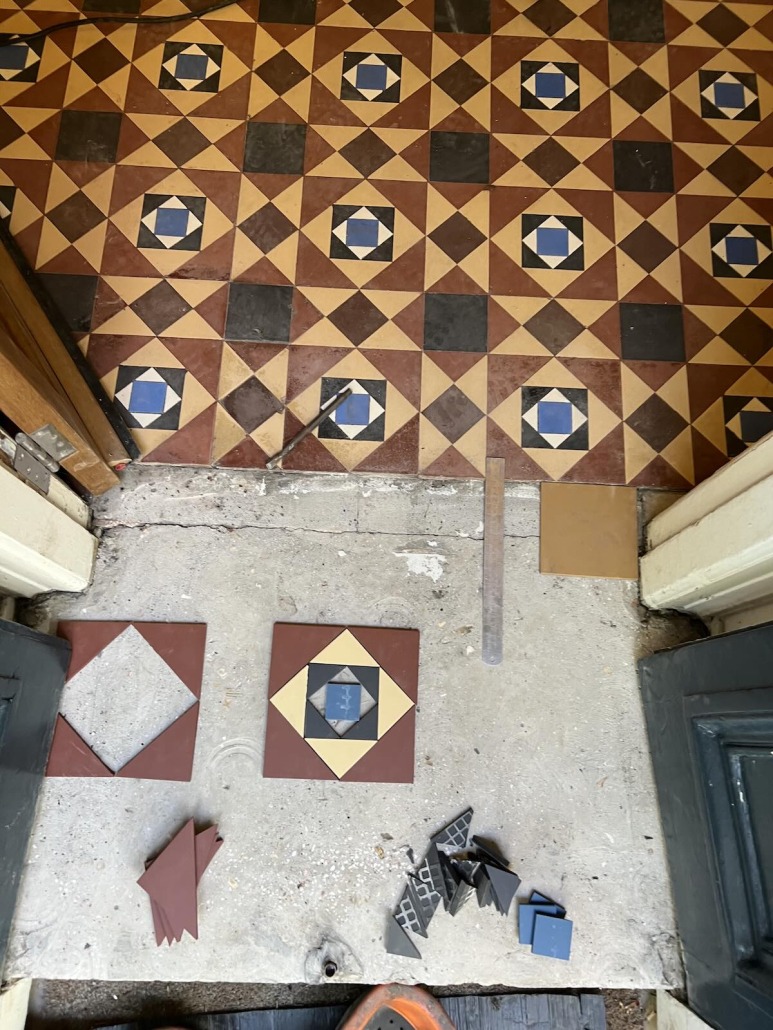
Above left: Photo of a Victorian tile floor extension and restoration in Edinburgh New Town, carefully extending the original historic geometric floor using individually cut and colour-matched tiles. The new section was set out to follow the existing Victorian pattern, preserving the character of the original floor while providing a durable and visually sympathetic repair.
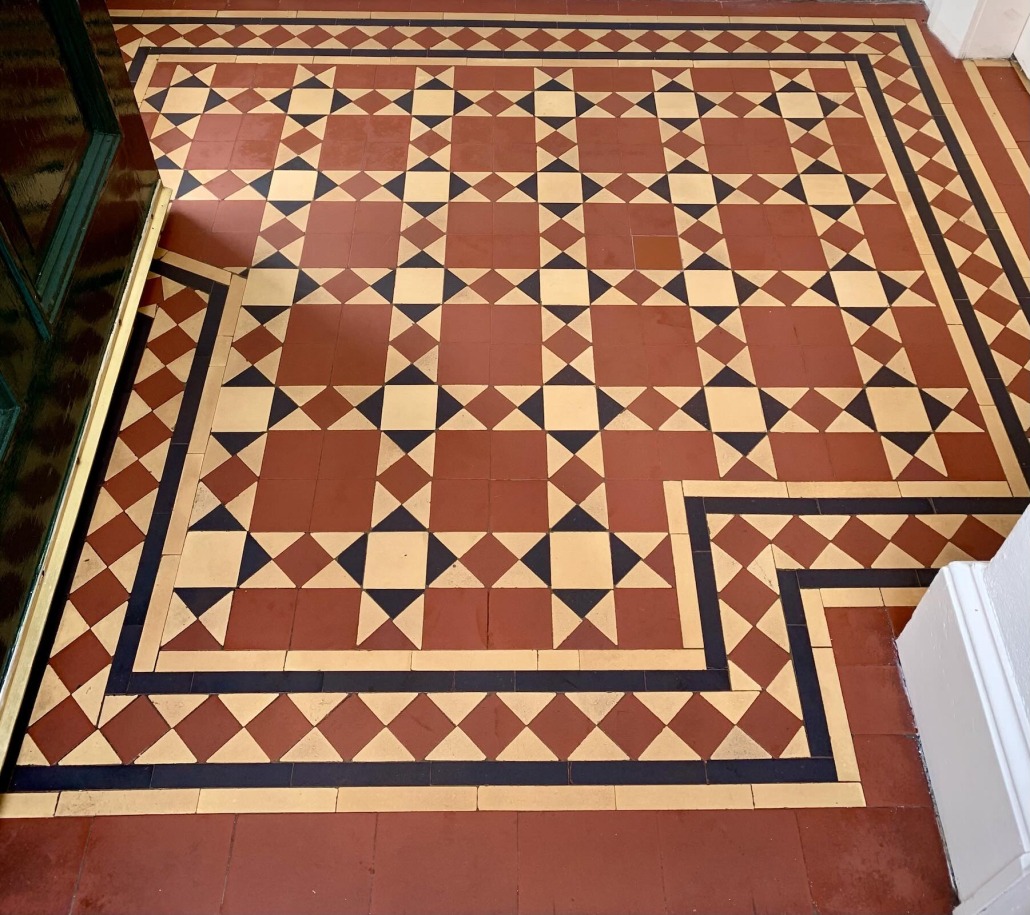
Above right: Photo of a New Victorian-style geometric tile floor installation in Pollokshields, Glasgow, designed and traditionally laid to complement the character of this period property. Individually set geometric tiles, detailed borders and carefully selected colours create an authentic Victorian appearance while providing a durable new floor for everyday use.
10. How do I arrange a quotation?
Obtaining a quotation is straightforward.
For most domestic Victorian tile restoration projects, simply email clear photographs, approximate dimensions, your location and a brief description of any known issues. In many cases we can prepare a detailed written quotation from photographs alone.
For larger or more complex projects, including listed buildings, churches, cathedrals and other historic properties, we may recommend a site visit or professional conservation condition survey before preparing a specification and quotation.
We undertake Victorian tile restoration, geometric tile repairs, mosaic conservation and encaustic tile restoration throughout Edinburgh, Glasgow, Aberdeen, Dundee, Perth, Stirling, Inverness, the Scottish Borders and across Scotland, together with specialist conservation projects throughout the UK.
Whether your project requires specialist cleaning, localised repairs, replacement tiles, complete restoration or professional conservation consultancy, we’d be pleased to discuss the most appropriate conservation approach. Please do contact us.
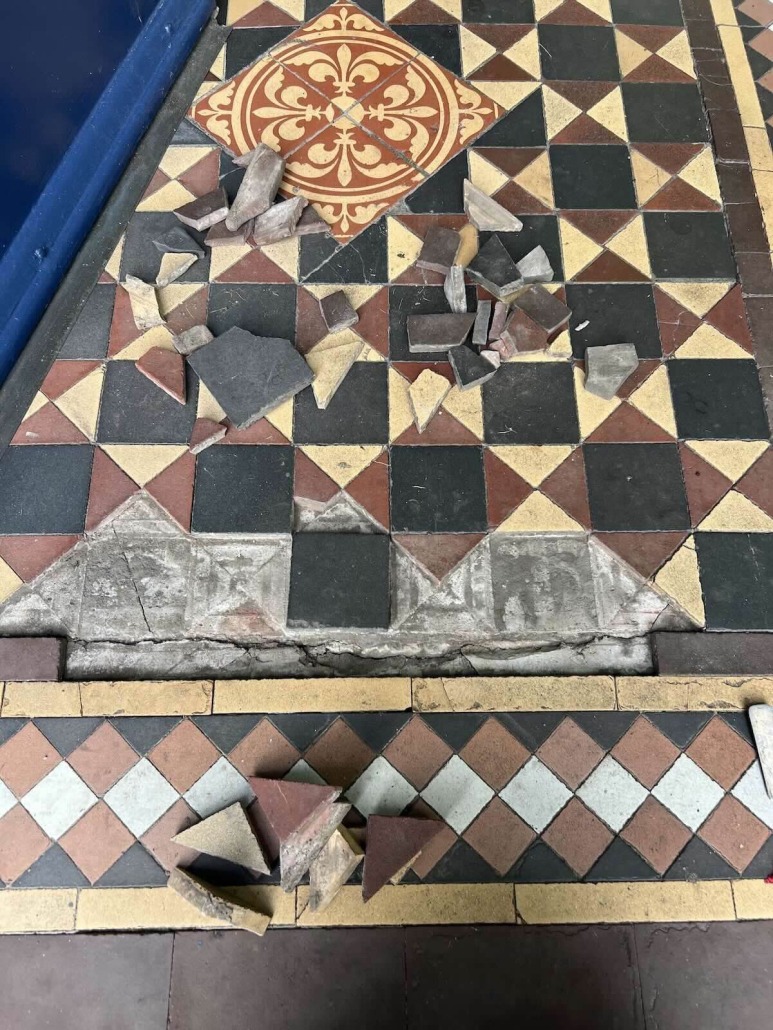
Photos above: Victorian tile floor restoration in Portobello, Edinburgh, showing the floor during conservation and after completion. The original floor had numerous damaged and missing tiles, together with ingrained staining and soiling. We retained and reused as many original Victorian tiles as possible, fitting closely matched replacements only where necessary before cleaning, repairing and conserving the floor.
Our approach to Victorian tile restoration in Edinburgh is not to make a 100-year-old floor look new. We retain the natural variation, age and historic patina that give Victorian floors their character, leaving them clean, stable and well cared for. The finished Portobello floor remains unmistakably historic — just properly conserved and ready for continued use.
Victorian Tile Restoration Across Scotland
From small Victorian entrance halls to important historic buildings, we’re proud to help preserve Scotland’s remarkable tiled floors and mosaics.
We provide Victorian tile restoration, repair and conservation across Scotland, including Edinburgh, Glasgow, Aberdeen, Dundee, Perth, Stirling and the Scottish Borders. Our work includes specialist cleaning, matching replacement tiles, geometric and encaustic tile repairs, mosaic conservation and new Victorian-style floors.
Every project is approached with the same aim: preserve as much original material as possible and bring these beautiful historic floors back to their best.
Have a Victorian floor that needs some attention? Send us a few photographs, approximate measurements and your location, and we’ll be happy to take a look and advise on the best way forward.
Some of our much valued clients

Blog
 Victorian Tile Restoration FAQs12 September 2026 - 13:35
Expert advice on Victorian tile restoration, cleaning, repairs, replacement tiles, costs and conservation, with examples from projects across Scotland.
 Victorian Tile Restoration in Edinburgh | Floor Repair & Cleaning3 December 2025 - 12:05
Specialist Victorian tile restoration project completed in Edinburgh, Scotland. Original geometric floor tiles were carefully repaired, replaced where necessary and sympathetically restored to preserve the historic character of the entrance vestibule.
